Have you ever been stuck deciding between A or B? React or Svelte? PhD or startup? Chocolate or vanilla? Wouldn't it be nice if you could split the universe in two, so that at least if you didn't make the right decision, you know there's a version of you in another universe that did?
It might sound crazy, but it takes about 4 seconds to run this circuit, which splits the universe in two and tells you which universe you're in. You can legitimately run it right now. [Edit: see quantumdiceroll.com]
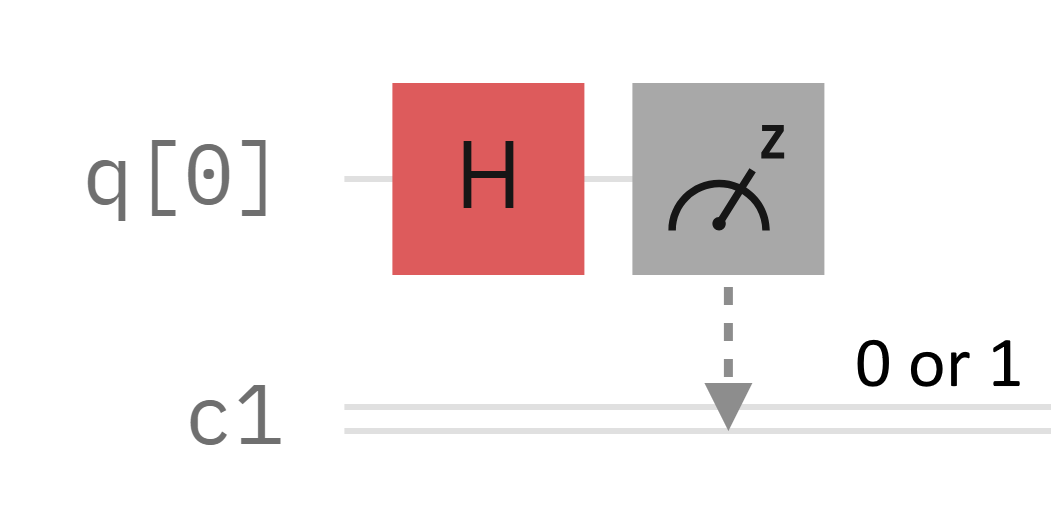
This circuit is basically a unix fork(). It prepares a qubit that's half 0 and half 1, and then immediately measures it for you.
The universe never lets you measure half a qubit, which means you're forcing the universe to make a decision for you.
This causes the universe to branch into two: in one branch it decides 0, and in another it decides 1.
You can determine which branch you're in based on whether the readout is a 0 or a 1, and make your decision based on that info.
You don't get to choose the readout. After all, some version of you needs to be willing to do either outcome for this to work. You do get to control the probabilities, though. This circuit is 50/50, but you can modify it to produce any other probability split, or just repeat it N times to get 1/2^N probability granularity.
There are two caveats:
-
For this to work, IBM's quantum computer must not have any measurement or decoherence errors. This circuit is laughably small though, and you can run big circuits today and still get coherent results, so this is usually a valid assumption.
-
I've been assuming many-worlds. However, even if you believe there's only one universe1, the implications are potentially just as meaningful. The outcome provably does not exist until you measure it2, which means the universe is making a decision for you live. It's just like a coin toss, but where the coin's outcome is completely nondeterministic to us; instead, it is determined by reaching beyond the fabric of our observable reality. If picking between flipping a normal coin and that coin, I'd like that one.
This really works. I won't comment whether I've really used it.
Footnotes
-
For example, the Copenhagen or Pilot Wave interpretation. ↩
-
At least effectively. The GHZ experiment is classic proof, but I prefer the delayed double slit experiment. ↩